To be honest, I have never downhill skied a day in my life - though I adored the Alpine Slide. I was born in an O'Connell's Sons building - the old Wesson Women's maternity wing in Springfield - in 1974. When I was growing up in Enfield and then Ellington, Connecticut, Mt. Tom marked what I considered the northern edge of our turf. My grandparents lived just across the river in South Hadley, and my father recalls falling asleep to the glow of night skiing streaming in his bedroom window. Whenever we went north up 91, which was frequent, seeing Mt. Tom on the return trip to me meant the journey was over - we were home. As we drove past I would stare out at the Ski Area billboard, fascinated that Little Tom hid the base area so effectively. Especially when the lights were on, Mt. Tom would pop up on the horizon in all kinds of places I never would have expected. Mt. Tom was simply always there.
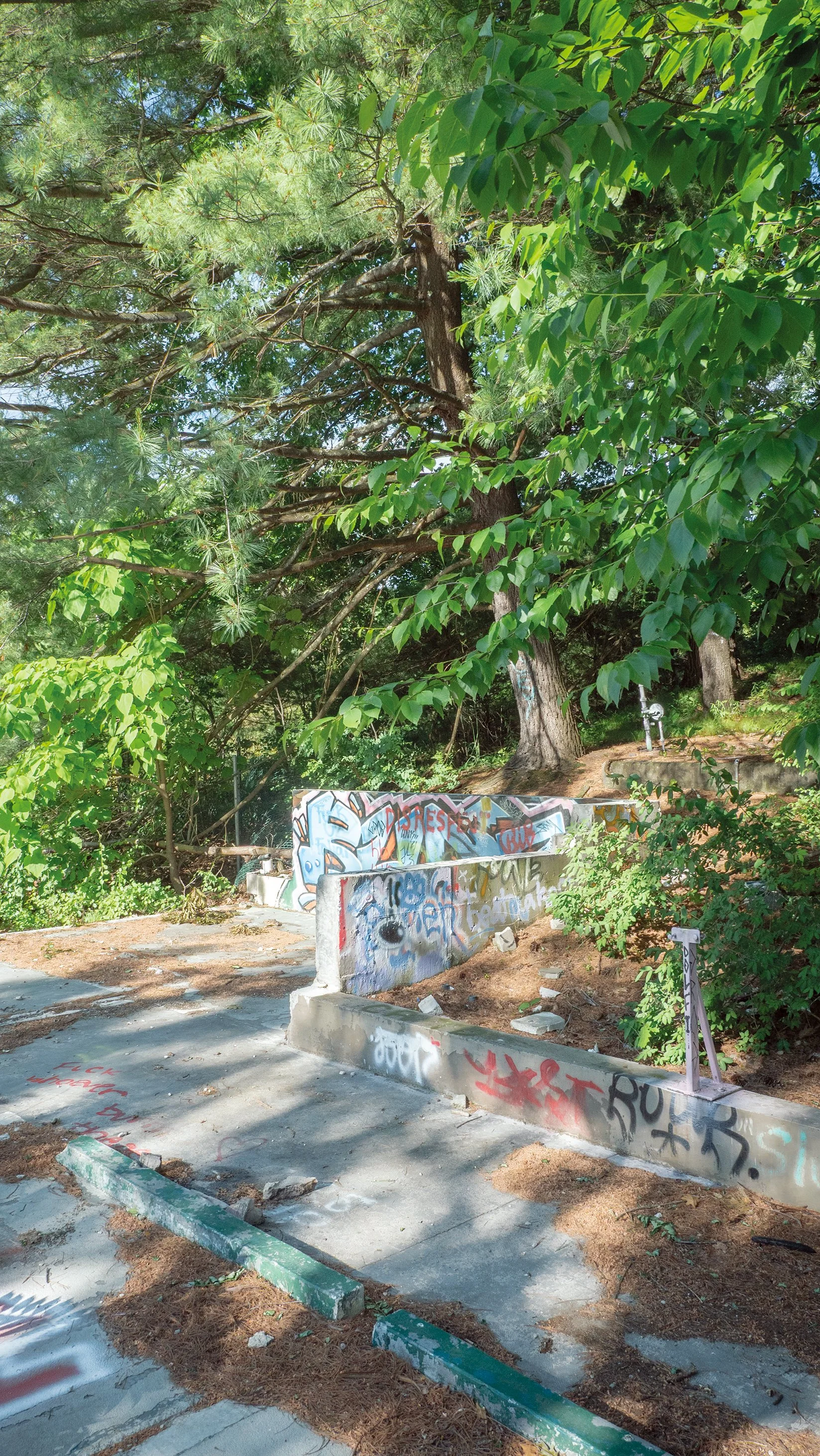
But the Ski Area was not. I had heard about the closure back in 1998 and many times wanted to come out and explore, but living carless in Boston for 25 years limited my travels - so I snooped at online satellite images instead. When I finally did make it out the Boys & Girls Club were still trying to protect it, so I did not trespass too much - which in hindsight I deeply regret. Once the lodge burned and the water slide buildings were torn down I went into documentation mode and explored as much of the property as I could - so much had already been lost.
Originally this was conceived as a book of photographs, with the historical content as a short appendix - a minimalist list of key dates and events at the end of the book. But the stories had a way of accumulating, and one thing I did not have in mind when I began was authoring a text. Therefore I let the archives of the Springfield Republican, Holyoke Transcript-Telegraph, Daily Hampshire Gazette and other Pioneer Valley & regional newspapers speak for the Ski Area. To those papers and their many editors, authors, researchers and archivists I am particularly grateful, not to mention NewsBank and newspapers.com for making the materials so accessible.
The tales Mt. Tom could tell would fill several volumes, and this book looks at a very narrow selection of them. The text included here is not intended as a comprehensive review of the Ski Area nor Mt. Tom itself. There are many related stories to be told, from race weekends to high school and college activities to a lengthy and distinguished history of ski training for the blind and mobility challenged. Then there is the quarry, an epic which could comfortably fill its own dense, rocky tome.
Still, a few side stories found their way in. The Ski Area may have happened eventually anyway, but the paths cut for the Holyoke Street and Mt. Tom Railways in the late 19th century unquestionably made it easier to get the project started. I am of the opinion that the story of the Ski Area truly begins with the Mt. Tom Railway, and therefore so does this book. I am also of the opinion that the story of the Ski Area itself sadly ended when the lights went out and the lifts stopped turning. Therefore, so does this book.
Soon there will be little left but some scattered rebar and red rubber snakes sneaking through the underbrush. I will miss the strange contradictory beauty and memories that the ruins have offered for so long. My hope with this work has been to capture that which is still shining through about the Ski Area before it vanishes completely, and give it back.
James M. Long
2025
Artist’s Statement